The numbers that flipped the market
The starting point is a price collapse. Lithium-ion battery pack prices fell below $90 per kilowatt-hour in 2025 and kept falling in 2026, driven by overcapacity in Chinese cell manufacturing and a new generation of cheaper chemistries. At those prices, the arithmetic of grid storage changed: in markets with high solar penetration, midday wholesale power can be near zero or even negative, while evening power is expensive. A battery that charges in the cheap hours and discharges in the expensive hours earns its capital cost back in four to seven years in the best markets - and that is before counting the grid services it gets paid for on top.
The result is a deployment curve with no precedent. Global grid-battery installations in 2026 are on track to roughly double the previous record year. The United States, China, Australia and Europe lead, but the boom is genuinely global: India, the Middle East and Latin America are all commissioning their first large-scale systems. BloombergNEF and the International Energy Agency both project that storage will be the fastest-growing source of new dispatchable capacity this decade - faster than new gas plants, faster than new nuclear.
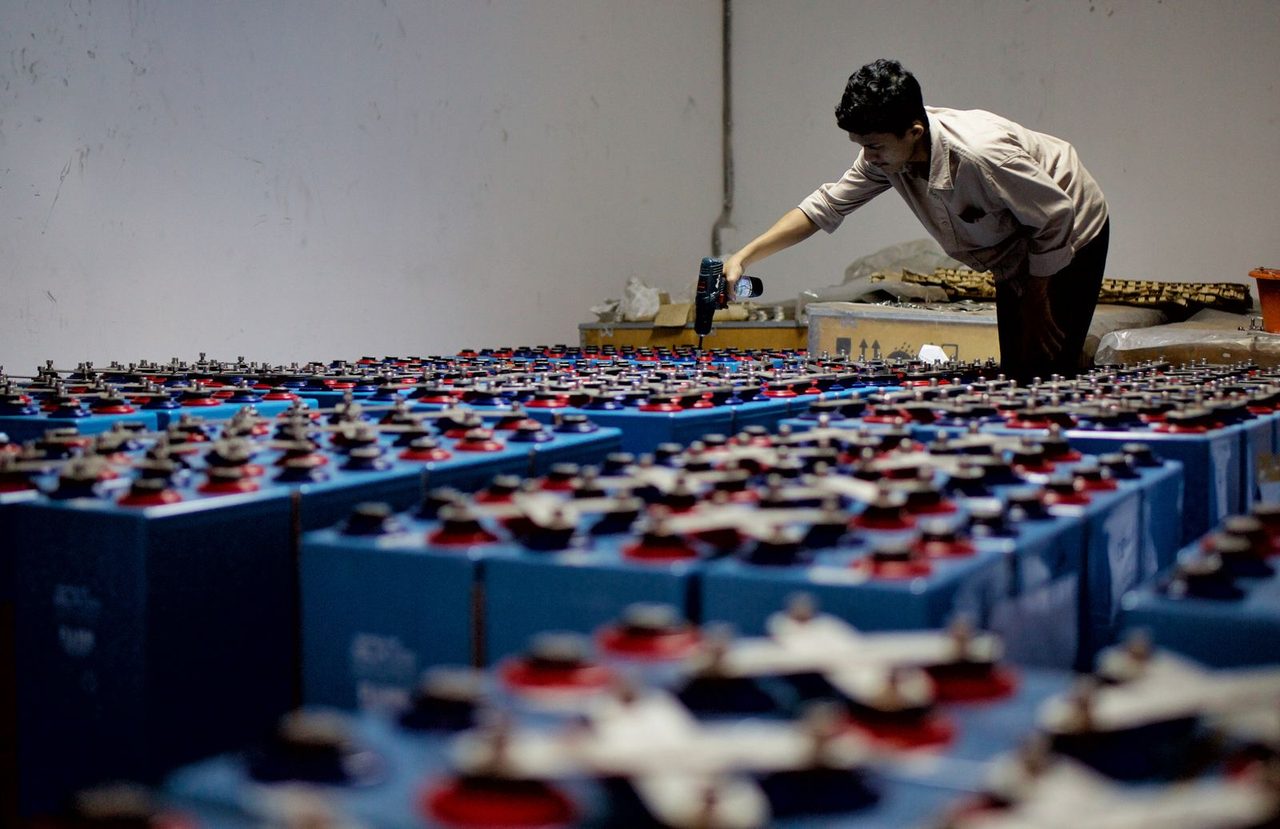
The scale of individual projects is changing too. A single installation in 2026 can store hundreds of megawatt-hours - enough to power a small city for hours - and developers are stacking battery plants next to solar farms and wind parks to create round-the-clock renewable supply. The industry talks about “clean firm power”: solar plus storage that can bid into capacity markets as a dispatchable asset, not just an intermittent one.
What batteries actually do for a grid
Storage performs several distinct jobs, and understanding them explains why it is valuable beyond the simple arbitrage story. The first is time-shifting: absorbing surplus midday solar and releasing it in the evening peak. The second is frequency response: batteries can react in milliseconds, far faster than thermal plants, which makes them the cheapest source of the fast regulation services that keep grid frequency at 50 or 60 hertz. The third is capacity: in regions where peak demand is short - a few hundred hot hours a year - batteries can cover those peaks more cheaply than building a gas peaker plant that runs for 5% of the year.
In several markets, this is no longer theoretical. California, Texas and Australia have reached “duck curve” territory where solar drives midday prices to zero, and grid batteries have become the marginal price-setter in the evening. The result is measurable: in California, batteries are now the single largest source of evening peak supply on many days, displacing gas plants that used to run every night. Texas saw the same pattern during 2025 and 2026 heatwaves, when storage helped keep prices from spiking to the state's cap.
The supply chain and the manufacturing race
The bottleneck is no longer demand - it is manufacturing and grid connection. Battery cell factories are being built at unprecedented scale, but the projects take three to four years from ground-breaking to production, and every gigawatt-hour of storage needs cells, racks, inverters and transformers. The transformer shortage is the quiet crisis of the industry: grid transformers are in short supply globally, with lead times stretching beyond two years, and transformers are needed for batteries, renewables and grid upgrades alike.
The grid connection queue is the other constraint. In the United States, thousands of storage projects are waiting in interconnection queues, in some cases for five years or more, because the transmission system was never designed for this volume of new supply. Reforming interconnection rules - allowing storage to queue for shorter studies, charging fees that reflect real costs, and prioritizing projects that relieve congestion - has become one of the most consequential energy-policy fights of the decade. The EU has similar queue backlogs, and Australia is building “renewable energy zones” specifically to accelerate connection.
The chemistry mix is widening beyond lithium. Sodium-ion batteries, which use abundant materials and are cheaper per unit of energy, entered commercial production in volume in 2026 and are increasingly paired with solar in long-duration applications. Iron-air batteries, which store energy for days rather than hours at a fraction of the cost, are being deployed in pilot projects. The industry is converging on a simple division of labor: lithium for power and short duration, sodium for cheaper energy, and iron-air or flow batteries for the multi-day gap that lithium cannot economically cover.
The software layer: where value is really made
A battery is a dumb box of chemicals; the intelligence lives in the software that decides when to charge and discharge. The best operators run forecasting models that predict solar output, demand and prices hours ahead, then optimize the dispatch across each 5-minute market interval. Companies like Fluence, Tesla and the specialist trading desks of the major utilities have turned battery operations into a high-frequency trading business, and the performance gap between the best and average operators is enormous - sometimes a factor of two in revenue per megawatt.
The software also matters for grid stability. Fast frequency response requires control systems that can switch from charging to discharging in under a second, and those systems must be certified, tested and maintained. As more storage connects, grid operators are rewriting their market rules to let batteries sell the full range of services - capacity, energy, frequency, voltage support - and the most advanced markets now pay batteries for flexibility itself, not just for the megawatt-hours they move.
The limits that no chemistry can fix
It is important to be honest about what storage cannot do. Batteries are energy-constrained, not power-constrained: a 4-hour battery covers the evening peak, but it cannot shift summer sun to winter wind droughts. Seasonal storage - the ability to move energy across months - needs different tools: pumped hydro where geography allows, green hydrogen produced in surplus seasons, and, in the future, longer-duration technologies that are still in the lab. Grid planners who pretend batteries alone can decarbonize the whole system are setting themselves up for disappointment.
The other limit is economic, not physical. Storage earns the most in markets with high solar penetration and price volatility, and it earns far less in markets where baseload coal or nuclear keeps prices flat. That is why the boom is geographically uneven: batteries follow price signals, and the price signals are strongest where renewables are already dominant. Countries that want to attract storage investment can do so by reforming market rules and allowing scarcity pricing - but the economics have to be real, not subsidized.
What it means for electricity prices and the transition
For consumers, the honest answer is that storage is a price-smoother, not a price-cutter. In the short run, batteries can reduce peak prices sharply - the 2025 and 2026 data from California and Texas shows evening price spikes moderating as storage grew. But batteries add their own cost, which is passed through in rates, so the net effect on average bills is roughly neutral. What storage does change is reliability: grids with plenty of storage are far more resilient to heatwaves, gas shortages and renewable droughts, because the stored energy is dispatchable on demand.
For the transition, storage is the unlock that makes high-renewable grids possible. Every grid-modeling study that assumes a decarbonized system also assumes massive storage capacity - the IEA's net-zero scenario calls for hundreds of gigawatts of grid storage by 2030, up from tens today. The industry is on track, but the pace depends on the two constraints identified above: manufacturing scale and grid connection. Solve those, and storage becomes the backbone technology of the clean grid - the bridge between the sun and the socket.
The bottom line
The grid-battery boom is real, fast and global. It is driven by a genuine cost revolution, it is reshaping electricity markets in real time, and it is the most important enabling technology for the second half of the clean-energy transition. The bottlenecks are industrial - cells, transformers, connection queues - and they are solvable with investment and policy. The next five years will tell us whether storage fulfils its promise or trips over its own supply chain. The direction, at least, is unmistakable.
Regional deep dive: California, Texas and Australia
The three regions that show what grid storage can do are California, Texas and Australia. California runs the largest battery fleet of any US state, and the data tells a clear story: batteries now routinely supply more than half of the state's evening peak demand on solar-heavy days, and the 'duck curve' - the midday plunge and evening surge in net demand that solar creates - has been flattened measurably since storage scaled. The California Independent System Operator's data shows that the evening ramp, once the grid's most stressful period, is now covered hour by hour by dispatched batteries.
Texas is the market-economics case. ERCOT, the state's independent grid, has minimal capacity markets and relies on real-time prices to signal scarcity - and batteries have responded to those signals at enormous scale. When a Texas heatwave pushes demand up and wind drops, battery operators are paid hundreds of times the average price for a few hours, and those spikes fund the next round of construction. Texas has added gigawatts of storage in two years, purely on price signals, with no subsidy programme - the cleanest demonstration that storage economics now stand on their own.
Australia is the grid-architecture case. The country has paired storage with the highest solar penetration on Earth - rooftop solar alone meets a large share of daytime demand in several states - and its grid operator has rewired the market rules to let storage, demand response and virtual power plants compete with gas. The 'big battery' in South Australia, built after a famous statewide blackout, has earned back its cost multiple times and has become a template exported around the world. Australia's lesson is that storage is not a bolt-on; it is a new kind of grid asset that requires market rules built for its speed and flexibility.
What the three regions share is a lesson for every grid: the value of storage is created by the market design around it. Batteries in regions with flat prices and no scarcity signals earn almost nothing; batteries in regions that price flexibility and reward fast response earn their keep many times over. The policy implication is straightforward - if you want storage investment, fix the market rules first, and the capacity will follow.
The workforce and the skills gap
The storage boom is creating an industrial workforce as fast as it is creating megawatts. Every project needs engineers, electricians, battery technicians and grid specialists, and the industry reports a genuine skills shortage - the US alone needs tens of thousands of additional energy-storage technicians this decade. Community colleges and vocational programmes are responding with dedicated storage certification tracks, and the battery manufacturers are building their own training academies at the factory sites.
The safety dimension of the workforce question is equally important. Grid batteries store enormous amounts of energy in flammable chemistry, and thermal runaway - the cascade failure that can ignite a battery rack - is the industry's worst-case scenario. The 2020s have seen a handful of high-profile battery fires, and while modern systems have multiple layers of protection - thermal monitoring, fire suppression, physical separation - the incidents have pushed regulators to write stricter codes for siting and operation. The technicians who install and maintain these systems are now certified against those codes, and the safety record has improved accordingly.
The recycling question follows the workforce question. A grid battery has a working life of ten to twenty years, after which its cells still hold most of their materials - lithium, nickel, cobalt - which can be recovered and reused. The battery-recycling industry is scaling alongside storage, and several projects now build second-life batteries - retired grid units repurposed for smaller applications. The loop is not yet closed, but the direction is clear: the storage boom is building the recycling industry it will need two decades from now.
The policy agenda
The policy agenda for storage has consolidated around five asks. The first is market reform: pay for flexibility, allow scarcity pricing, and let batteries sell every service they can provide. The second is interconnection reform: clear the queues that keep storage projects waiting years. The third is manufacturing incentives: the tax credits and industrial policies that are attracting cell, pack and inverter factories. The fourth is siting and safety codes: consistent rules that let developers build fast without compromising safety. The fifth is procurement: governments that contract for long-duration storage as a strategic reserve, signalling demand for technologies that are not yet commercial.
The politics of storage are surprisingly benign compared with other energy technologies. Batteries are quiet, compact, produce no emissions and create local jobs - there is no equivalent of the wind-turbine visual battle or the nuclear waste debate. The main local friction is grid connection and land use, which are manageable. This political favour is one reason storage has scaled so fast: it is one of the few energy technologies with broad public acceptance across the political spectrum.
The macro picture is that storage is now central to every credible energy plan. The IEA's scenarios, the EU's REPowerEU plans, the US national electrification strategies - all of them treat grid storage as a foundational layer, not an option. The countries that recognised this early are reaping the rewards in lower prices, cleaner grids and a growing export industry. The countries that are late are discovering that storage is not a nice-to-have; it is the hinge on which the whole transition turns.
The investor view
The investment community has moved storage from a niche theme to a core holding in clean-energy portfolios. The growth story is legible: double-digit installation growth, falling costs, proven revenue models and a policy tailwind in every major market. The funds that bet on solar and wind a decade ago are now allocating to storage as the 'pick and shovel' play - the enabling technology that benefits no matter which generation technology wins. The public markets have storage pure-plays trading at significant premiums, and the private markets are funding the supply chain from cells to software.
The risk factors the investors watch are the same ones the industry worries about. The first is overcapacity: the cell factories being built could overshoot demand, as they did in the solar panel industry, crashing prices and margins. The second is the technology transition: sodium-ion and iron-air could disrupt lithium's dominance, stranding investment in lithium-specific assets. The third is policy dependence: the markets where storage earns the most are the ones with aggressive renewables targets, and a political reversal would remove the price signals that make storage profitable. The sober assessment is that storage has the same cyclical risks as every hardware industry - and the same long-term tailwind.
The investor calculus is ultimately about duration. A grid battery is a 15-20 year asset with predictable revenue under contract in many markets, which makes it attractive to infrastructure funds that buy long-lived, cash-generating assets. The merchant markets - where batteries earn from wholesale arbitrage and grid services - are higher-risk but higher-return, and they attract the trading houses and specialist operators. The combination has created a genuinely deep capital market for storage, which is itself a sign of maturity: the industry no longer depends on a handful of project-finance banks; it has the full range of debt and equity instruments.
A realistic timeline for the next decade
Looking forward, the storage trajectory splits into three phases. The current phase - lithium batteries for 2-4 hour applications - will continue to scale for the rest of the decade, driven by falling costs and the evening-peak economics. The second phase, beginning in the late 2020s, adds sodium-ion at scale for cheaper energy and iron-air or flow batteries for the 8-24 hour gap, enabling grids to ride through longer renewables droughts. The third phase, in the 2030s, integrates storage with hydrogen and pumped hydro for the seasonal problem - shifting summer sun to winter demand. Each phase is a decade-long build-out, and each depends on the one before.
The realistic milestones: by 2030, global grid storage should reach the hundreds of gigawatts the IEA's scenarios call for, storage should be the default peaking resource in most major markets, and the first long-duration plants should be operating commercially. By 2040, storage plus renewables should be the cheapest firm power available in most of the world, and the fossil peaker plants that storage is replacing will be mostly retired. The path is not without obstacles - the supply chain, the queues and the market rules all need to keep pace - but the direction is as close to certain as anything in energy.
The final thought is about what storage enables beyond electricity. A grid with abundant, cheap storage changes the economics of everything downstream: it makes electrified transport cheaper (because the charging load can be shifted), it makes electrified industry feasible (because firm power is available), and it makes the whole system more resilient to shocks - weather, fuel prices, geopolitics. The storage boom is often told as a story about batteries, but it is really a story about what happens when clean energy becomes reliable. That is the quiet revolution, and it is already underway.
Sources & further reading
- IEA - Grid-Scale Storage special report — https://www.iea.org/reports/grid-scale-storage
- BloombergNEF - Battery Pack Prices 2025/2026 — https://about.bnef.com/blog/
- California ISO - Storage and renewable integration data — https://www.caiso.com/
- ERCOT - Battery storage market operations — https://www.ercot.com/
- Energy Storage News - transformer shortage coverage — https://www.energy-storage.news/
- US DOE - Interconnection queue reform — https://www.energy.gov/
Frequently asked questions
Why are grid batteries being installed so fast in 2026?
Battery prices fell below $90/kWh, making storage profitable wherever solar creates midday surpluses. Batteries charge when power is cheap and discharge in the evening peak, and they also earn money from fast grid services. The combination flipped the economics in major markets.
How long can a grid battery store energy?
Most commercial systems store 2 to 4 hours of energy at rated power. Newer long-duration technologies - sodium-ion, iron-air, flow batteries - target 8 hours to several days. Seasonal storage across months still needs pumped hydro or hydrogen.
Does storage lower electricity bills?
Storage moderates peak prices, which reduces the most extreme price spikes, but it adds its own cost. The net effect on average bills is roughly neutral; the main benefit is reliability and resilience during heatwaves and supply shocks.
Vendor and regulator figures are as published by the organisations above; the analysis and any derived comparison are ours.
Luminesca · Independent analysis · About · Privacy
This page is an informational compilation. For reference only.
Images: Pexels (free license) · Photos by contributors on Pexels.
Privacy Policy