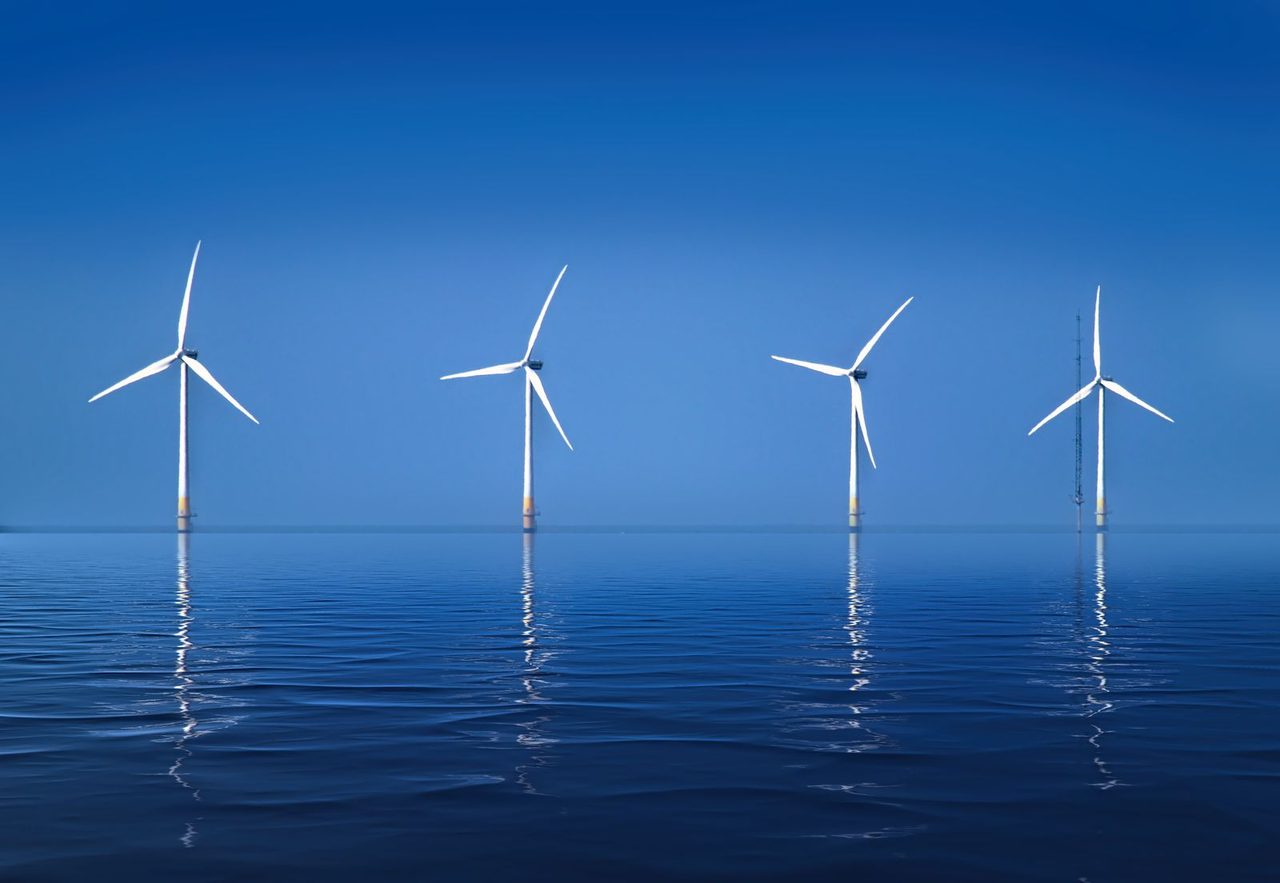
From niche to the fastest-growing source
For most of its history, offshore wind was the expensive cousin of onshore wind and solar. That is no longer true. Global capacity passed 100 gigawatts in 2026, and annual installations are setting records. More importantly, the cost curve bent: the levelised cost of offshore wind has fallen by more than half in a decade, and in the most recent European and Asian auctions, winning bids undercut new gas and coal on a levelised basis. The technology went from subsidy-dependent to commercially competitive in the span of a single decade.
The geography of the boom is widening. Europe remains the largest market - the North Sea is the most developed offshore region on Earth - but Asia is closing fast. China installs more offshore capacity in a single year than any other country, and Japan, South Korea, Taiwan and Vietnam are all building their first large-scale projects. The United States is finally scaling, with the first commercial-scale farms in the Atlantic coming online in 2025-2026 after years of delays, and the Pacific coast waiting on floating technology.
Floating wind: the technology that unlocks deep water
Fixed-bottom turbines are limited to water depths of about 60 metres - beyond that, the steel substructures become uneconomical. Floating wind solves this by mounting turbines on buoyant platforms moored to the seabed, like giant tethered boats. That opens up the deep-water sites where wind is stronger, more consistent and closer to the big coastal demand centres - which is exactly where the next generation of projects is being built.
Floating wind is where onshore wind was fifteen years ago: promising, rapidly improving, and just entering commercial scale. The first commercial floating farms are operating off Scotland, Portugal and Norway, and gigawatt-scale floating projects are in development off France, Spain, Japan and the US West Coast. The cost of floating platforms has fallen sharply as designs have converged - the industry is consolidating around semi-submersible and spar designs - and the projection is that floating costs reach parity with fixed-bottom within the next decade.
The engineering challenges are real. Mooring systems must hold a turbine with 200-metre blades stable in deep water. Cables must carry power from turbines floating kilometres offshore back to shore. Installation requires specialized vessels that are in short supply. And the turbines themselves - the largest now standing over 250 metres tall - must be assembled at ports that can handle their weight. Every one of these is a bottleneck, and every one is being invested in.
The supply-chain squeeze: vessels, ports and transformers
The single biggest constraint on offshore wind in 2026 is not turbines - it is the installation fleet. Laying offshore wind farms requires heavy-lift jackup vessels that can lift turbine components 150 metres above the sea, and cable-laying vessels for the export cables. The global fleet is measured in dozens, not hundreds, and it is fully booked. The industry calls this the “vessel cliff”: every major market is competing for the same small fleet, and charter rates have tripled in three years.
Ports are the second bottleneck. Assembling a modern offshore turbine requires a port with a heavy-lift quay capable of holding thousands of tonnes, deep-water access for the installation vessels, and storage space for blades and towers. There are only a handful of such ports in Europe, and the planned build-out requires many more. Governments are now investing directly in port infrastructure - the EU's offshore wind strategy includes billions for port upgrades, and the US is following with federal port grants.
Transformers and cables are the quieter constraint. Every farm needs an offshore substation, an export cable to shore, and grid connection infrastructure. The global transformer shortage that is squeezing the whole electricity sector hits offshore wind hardest, because offshore transformers are custom-built for saltwater environments. Cable manufacturers are also at capacity, with order books extending years into the future.
The economics: how the costs fell and where they could go
The cost story is a classic learning curve. Every doubling of cumulative installed capacity has cut costs by roughly 15-20%, driven by bigger turbines, better installation methods and economies of scale. The largest turbines of 2026 sweep an area larger than several football pitches and generate 15+ megawatts each - twice the output of the machines installed a decade ago. Fewer, bigger turbines mean fewer foundations, fewer cables and lower cost per megawatt.
But the industry hit a rough patch in 2024-2025, when inflation, higher interest rates and supply-chain costs squeezed project margins, and several developers wrote down projects or renegotiated contracts. The recovery in 2026 is real but uneven: auctions are being won at prices that would have seemed impossible a few years ago, yet some projects remain uneconomic without support. The market is consolidating - smaller developers are being absorbed by larger ones with stronger balance sheets - and that consolidation is stabilising the industry.
Energy security: the new driver
The deepest shift in the politics of offshore wind is security. After the energy crisis of 2022, governments stopped treating offshore wind purely as a climate tool and started treating it as a strategic asset: home-grown, dispatchable-ish, and immune to embargoes. The North Sea is now described by its governments as a “green power plant for Europe”, and the EU is planning offshore grid connections that would link multiple farms - and even multiple countries - into a single European super-grid.
The security framing changes the cost-benefit calculation. When governments value offshore wind for its resilience benefits - reducing dependence on imported gas, insulating the economy from price shocks - they are willing to pay a modest premium over the pure levelised cost. That is one reason the build-out is accelerating even in markets where onshore wind and solar are cheaper: offshore wind offers something the others do not, which is scale close to the demand, and consistency driven by stronger sea winds.
The environmental questions
Offshore wind is not without environmental trade-offs. The turbines affect bird migration routes, and some studies show seabird collisions and displacement. The foundations create artificial reefs that change local ecosystems - sometimes positively, sometimes not. The cable installation disturbs the seabed, and there are concerns about noise during construction affecting marine mammals. The industry has responded with mitigation: bird-detection systems that slow or stop turbines during migrations, bubble curtains that muffle piling noise, and siting that avoids the most sensitive areas.
The environmental groups that once fought offshore wind have largely accepted it, because the climate case is overwhelming - offshore wind displaces fossil generation directly, and its lifecycle emissions are a tiny fraction of gas or coal. The remaining fights are about where, not whether: fisheries oppose siting in productive fishing grounds, and coastal communities sometimes object to the visual impact. The industry's answer is to engage early and compensate well, because a wind farm that fights its neighbours for a decade is a wind farm that never gets built.
What to watch in the next five years
The next five years will be decided by three things. First, whether the vessel and port bottlenecks are resolved - the industry needs roughly double the current installation fleet to meet its targets, and every year of delay compounds. Second, whether floating wind delivers on its promise - the first gigawatt-scale floating projects will be the proof point, and their costs will set the trajectory for the deep-water markets of Japan, the US West Coast and beyond. Third, whether the economics survive the next cost cycle - the industry is cyclical, and the current boom will eventually face a down-cycle that separates the strong players from the weak.
The direction, though, is not in doubt. Offshore wind is the only clean technology that can deliver very large amounts of power close to the world's biggest coastal demand centres, and its costs are still falling. Every major energy forecast - from the IEA to the national grid plans of Europe, Asia and the Americas - assumes offshore wind grows into one of the largest sources of new electricity this decade. The race is on, and the farms being built today are the infrastructure that will power the 2030s.
The North Sea: Europe's offshore power plant
The North Sea is the world's most mature offshore wind region and the test bed for everything the industry is scaling elsewhere. Hundreds of wind farms are connected across UK, Dutch, German, Danish, Belgian and Norwegian waters, and the seabed is becoming a shared industrial grid - countries are planning 'energy islands' and hybrid interconnectors that link multiple countries' farms into one network. The North Sea 'super-grid' is the most ambitious example of international electricity cooperation on Earth, and it is being built one cable at a time.
The UK has been the market leader, with more installed capacity than any other country and a supply chain that spans turbine manufacturing, installation and operations. The Danish and Dutch industries are the engineering pioneers, Norwegian firms bring offshore oil-and-gas expertise to the wind sector, and Germany is scaling fast after a slow start. The European picture is of a shared industry with national specialities - and a common problem: the North Sea is running out of the easiest sites, pushing projects into deeper water where floating wind becomes necessary.
The labour story is a European success. Offshore wind now employs hundreds of thousands across the continent, and the jobs are durable - turbines need maintenance for their full twenty-five-year life, and the operations-and-maintenance sector grows every year. The industry has become a significant employer in coastal regions that lost fishing and shipbuilding jobs, and the skills are transferable: ex-oil-and-gas workers are the backbone of the offshore wind workforce, a conversion the industry is actively managing.
Asia's offshore wind surge
Asia is where the next wave of offshore wind will be built. China dominates the global numbers - it installs more offshore capacity in a year than the rest of the world combined - and its turbine manufacturers have become global exporters, undercutting European and US rivals on price. The Chinese build-out is driven by industrial policy and coastal demand: the eastern provinces, home to most of China's population and industry, sit next to some of the world's best shallow-water wind resources.
Japan, South Korea and Taiwan are the deep-water pioneers of Asia. All three have steep coastlines and strong wind resources close to demand, and all three have made floating wind central to their plans - Japan's floating wind ambitions are the most developed, with a pipeline of projects and a government target that treats offshore wind as a pillar of energy security. The Pacific-facing sites that these countries are developing are the proving ground for floating technology at scale.
Vietnam, the Philippines and Indonesia are the frontier markets. They have enormous offshore resources, rapidly growing electricity demand and coastlines built for the technology - but they are starting from near zero, with weak grids and young regulatory frameworks. The development banks are financing the first projects, and the pattern of the past is repeating: the countries that build the legal and grid framework early attract the investment, and the laggards watch the opportunity pass.
The technology roadmap
The technology roadmap for offshore wind has four chapters. The first is turbine scale: the next generation of machines pushes past 20 megawatts, with rotors wider than a football field. The second is floating platforms: semi-submersibles and spars that push into water depths beyond 200 metres, opening the deep-water resource that dwarfs the shallow-water capacity exploited so far. The third is hydrogen integration: offshore wind farms powering electrolysers at sea, producing green hydrogen that is piped ashore or shipped - turning the farm from a power plant into an energy hub.
The fourth chapter is digitalisation. Modern farms are controlled by software that predicts turbine loads, optimises maintenance windows and integrates with grid forecasts. The operations-and-maintenance industry is being transformed by drones, robots and predictive analytics - inspection drones fly the blades, underwater robots check the foundations, and machine-learning models predict component failures before they happen. The result is that modern offshore wind farms run at availability rates above 95%, numbers that would have been unthinkable a decade ago.
The research pipeline points further: superconductor generators that could halve turbine weight, vertical-axis designs for extreme deep water, and co-located aquaculture that farms fish beneath the turbines. Not all of these will scale, but the industry's willingness to experiment is itself a sign of maturity. Offshore wind is no longer a single technology; it is an industrial system that keeps finding new ways to generate power from the wind.
The economics in numbers
The offshore wind cost story is best told in numbers. In 2010, the first large offshore farms cost well over $200 per megawatt-hour to build and run. By 2020, the average was below $100. In the most competitive auctions of 2025-2026, winning bids have come in below $60 - and in a few cases below $40, which undercuts new gas and coal on a levelised basis in most markets. The learning rate - the cost reduction per doubling of installed capacity - has held at roughly 15-20%, the same curve that transformed solar and onshore wind.
The capital-intensity is the flip side of the cost success. Offshore wind is a front-loaded industry: the bulk of the cost is the turbine, the foundations, the installation and the connection, paid before the first megawatt-hour flows. That makes offshore wind sensitive to the cost of capital - a one-point rise in interest rates adds significantly to the levelised cost - which is why the 2024-2025 rate hikes hurt the industry even as the technology improved. The recovery of 2026 reflects both lower rates and a supply chain that absorbed the shocks.
The auction design has become a policy instrument in its own right. The European auctions use a 'contract for difference' model, where the government guarantees a price and the developer rebates anything above it - which gives developers revenue certainty and taxpayers a share of the upside when prices are high. The US has moved from the old production tax credit to a more complex stack of credits and state mandates. The auction results are now the most watched data in the industry, because they reveal the true cost curve and the health of the supply chain.
The skills and workforce challenge
The offshore wind workforce is growing but unevenly distributed, and the skills gap is a genuine constraint on the build-out. The industry needs engineers, marine specialists, turbine technicians, cable layers and port operators - and the training pipeline is shorter than the demand. The offshore wind technician is becoming a recognised trade, with certification programmes, specialist colleges and union representation, and the salaries are competitive with the oil and gas jobs the industry is drawing workers away from.
The transfer from oil and gas is the industry's quiet strength. The skills that offshore wind needs - working at height, working offshore, marine logistics, subsea operations - overlap heavily with the oil and gas workforce, and the industry has become the natural landing place for energy workers seeking a more stable future. The transition is not frictionless - the pay, the culture and the schedules differ - but the pipeline is real, and the industry's ability to absorb oil and gas talent is one reason it can scale as fast as it does.
The education system is responding. Several countries have established dedicated offshore wind programmes at technical colleges and universities, and the manufacturers run their own academies at the factory sites. The European Union's 'skills for offshore renewables' initiative and similar programmes elsewhere are funding the training capacity. The workforce story is a reminder that the energy transition is not just a technology project; it is a labour-market transformation, and the countries that train their people well will build their projects faster.
The bottom line for the decade
The outlook for offshore wind over the next decade is one of scale and consolidation. The installed base will roughly triple, floating wind will move from pilot to commercial, and the industry will become one of the largest sources of new electricity in the world's coastal economies. The bottlenecks - vessels, ports, transformers, skills - will be progressively solved, because the economics and the policy support make solving them worthwhile. The survivors of the current consolidation will be the vertically integrated players with balance-sheet strength and supply-chain depth.
The risks that could slow the build-out are identifiable: a prolonged cost-of-capital squeeze, a supply-chain shock, permitting reform that fails, or a political reversal in a key market. None of these would stop the industry - the cost curve and the security argument are too strong - but each could delay projects by years and raise costs. The industry's record of navigating its own crises suggests it will adapt, as it did after the 2024-2025 margin squeeze, by consolidating, innovating and rebuilding.
The final perspective is historical. Offshore wind went from experimental to the fastest-growing clean technology in a single decade - a speed of transition that would have seemed impossible when the first farm connected in the 1990s. The technology that was once dismissed as too expensive and too difficult is now the default choice for coastal grids, and its growth is limited only by the physical constraints of building at sea. The race of 2026 is not about whether offshore wind will be huge - that is decided. It is about who builds it, who owns it and who profits from it.
Sources & further reading
- GWEC - Global Offshore Wind Report 2026 — https://gwec.net/
- IEA - Offshore Wind Outlook — https://www.iea.org/topics/renewables
- European Commission - Offshore Wind Strategy — https://energy.ec.europa.eu/
- WindEurope - Offshore wind statistics — https://windeurope.org/
- US DOE - Offshore Wind Market Report — https://www.energy.gov/eere/wind
- Rystad Energy - Offshore wind cost analysis — https://www.rystadenergy.com/
Frequently asked questions
Why is offshore wind growing faster than onshore wind and solar?
Offshore wind benefits from stronger, more consistent sea winds, proximity to coastal demand, and fewer land-use conflicts. It has also fallen in cost by more than half in a decade. Solar and onshore wind are still growing, but offshore wind is the fastest-growing source in percentage terms in 2026.
What is floating wind and why does it matter?
Floating wind mounts turbines on buoyant platforms instead of fixed foundations, allowing them to operate in water deeper than 60 metres. It unlocks the deep-water sites - off Japan, the US West Coast, Spain, France - where the strongest wind resources are, and its costs are expected to reach parity with fixed-bottom wind within a decade.
What are the main bottlenecks holding back offshore wind?
The installation vessel fleet, which is small and fully booked; port infrastructure capable of handling giant turbines; and the global shortage of grid transformers and export cables. All three are being addressed with investment, but they are the binding constraints on the build-out pace.
Vendor and regulator figures are as published by the organisations above; the analysis and any derived comparison are ours.
Luminesca · Independent analysis · About · Privacy
This page is an informational compilation. For reference only.
Images: Pexels (free license) · Photos by contributors on Pexels.
Privacy Policy